Heading into Saturday’s match up between the St. Bonaventure Bonnie’s and the St. Louis Billiken’s, there are several implications at stake:
- The Bonnie’s need one more win to get to 20 wins for the fourth time in five years.
- A-10 championship rematch.
- St. Louis is hot! They are riding a four-game win streak into Saturday including wins against URI and VCU.
- Which Bonnie’s team will show up? The one that lost to La Salle or the team that beat Richmond?
- But you also may be wondering, WHAT IS A BILLIKEN AND A BONNIE?
- Billiken:
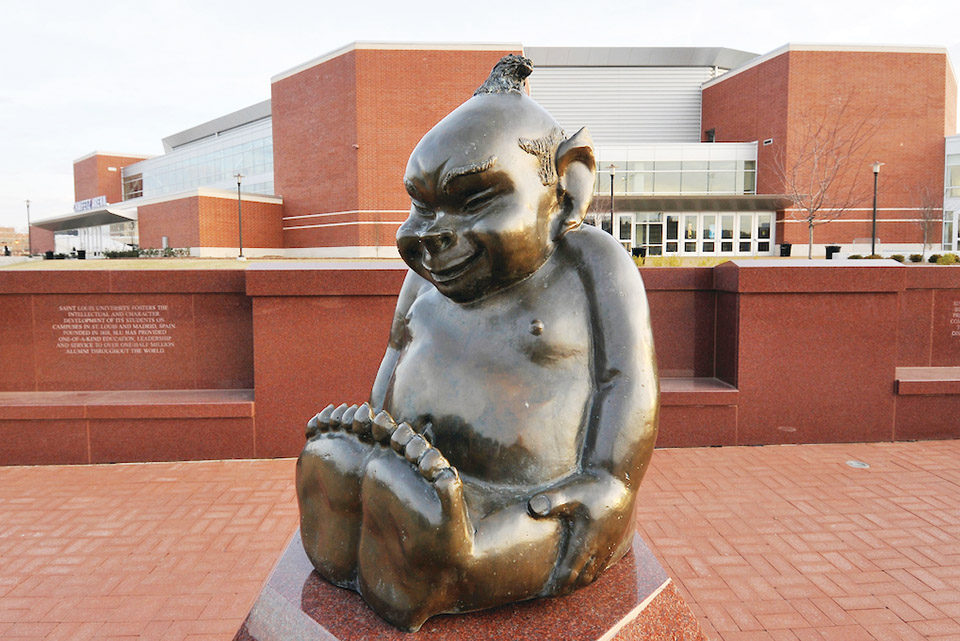
According to the school’s official website, a Billiken is a mythical good luck charm and represents, “things as they ought to be.” Back in the day, Billikens were molded and sold into candies, dolls, salt and pepper shakers and more. Buying or receiving a Billiken was a sign of good luck. The creator of the Billiken, Florence Pretz a Missouri art teacher, patented her design in 1908. She got the name from a poem she read by Bliss Carman. The Billiken is also found in all different parts of the world. In Osaka, Japan, a wooden Billiken statue sits in Tsutenkaku Tower, where visitors rub his feet for good luck. In Alaska, Eskimos keep the Billiken in carvings as good luck charms. In Argentina, it is the name of the world’s longest-running children’s magazine. And on the south side of Chicago, the school starts with the annual Bud Billiken Parade. But how did St. Louis pick the Billiken as their mascot? According to the school’s official website, it is said that in 1910 a cartoonist drew a picture of the St. Louis football coach, John Bender, in the shape of a Billiken which hung in a drugstore. From that point on, the football team became known as “Benders Billikens.” In another version, Bender walked into the drugstore and was greeted by the owner saying, “Bender you’re a real Billiken!” William O’Connor, a noted sportswriter, was there, and took up the name for Bender. Eventually all St. Louis teams became known as the Billikens.
Bonnie:

Before students attended St. Bonaventure, I’m sure at one point they asked themselves, “what is a Bonnie?” I think we have all been there. A few years in to my school year, I still get asked what my mascot is from time to time. Essentially, it is a shortened version of Bonaventure molded into the word Bonnie. In the early 1900’s St. Bonaventure picked the Brown Indians as their mascot after their color and the neighboring Seneca Nation, in Salamanca. In 1992, they changed their mascot to the Bonnies after other Native American mascot schools started adopting new names.
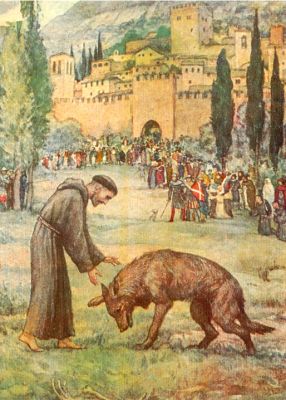
In 1999, a wolf was introduced as part of the mascot imagery. They picked a wolf after the famous story of St. Francis of Assisi taming the wolf at Gubbio. The great wolf was attacking the livestock of where St. Francis lived, and all who tried to stop the wolf were killed. It is said, that the great wolf charged at St. Francis but was stopped by the sign of the cross Francis held with his fingers. As you can see in the picture, Francis and the wolf made a truce. No one would attack the wolf if it stopped attacking them and they would feed the wolf regularly. According to The Little Flowers of Saint Francis, “Afterwards that same wolf lived in Gubbio for two years, and he tamely entered the houses, going from door to door, without doing any harm to anyone and without any being done to him; and he was kindly fed by the people….Finally after two years Brother Wolf died of old age, at which the citizens grieved very much.” St. Francis of Assisi is a huge part of the coursework taught at St. Bonaventure by Bob Donius and other professors to this day.
 Tom Doyle Blog